
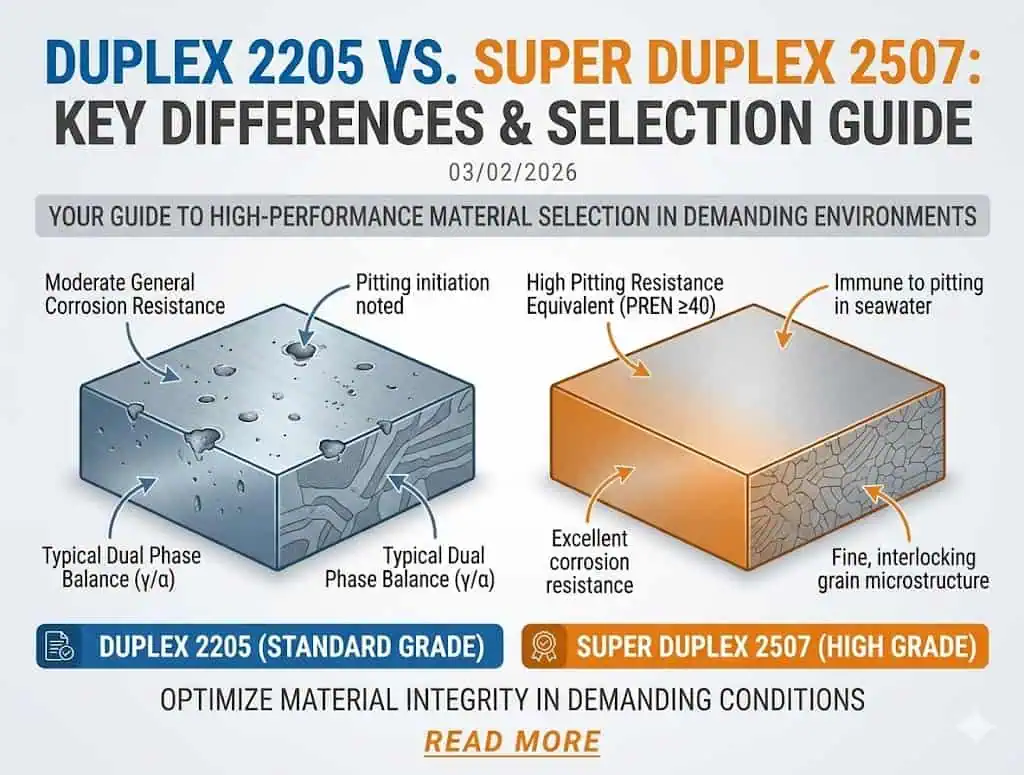
Meta Description: Explore duplex stainless steel sheets. Understand the dual austenite-ferrite microstructure balance, high yield strength, superior pitting resistance (PREN > 35), and practical guidelines for welding and forming.
Target Keywords: duplex stainless steel sheet, 2205 duplex steel, lean duplex sheets, PREN pitting resistance, welding duplex stainless steel
Duplex stainless steel sheets feature a two-phase microstructure consisting of roughly equal proportions of austenite ($gamma$) and ferrite ($alpha$). By combining the stress-corrosion cracking resistance of ferritic steels with the toughness and ductility of austenitic steels, duplex alloys provide a compelling alternative to traditional 300-series stainless steels.
With yield strengths double those of Grade 304 or 316, duplex sheets allow designers to reduce sheet thickness, cut overall structural weight, and extend service life in harsh chemical and offshore environments.
1. Microstructural Balance and Chemical Composition
The performance of duplex stainless steel relies on maintaining a balanced microstructure of approximately 50% austenite and 50% ferrite. Achieving this balance requires precise alloying control during melting and heat treatment:
-
Ferrite Stabilizers: Chromium ($text{Cr}$), Molybdenum ($text{Mo}$), and Silicon ($text{Si}$) promote the body-centered cubic (BCC) ferrite phase.
-
Austenite Stabilizers: Nickel ($text{Ni}$), Nitrogen ($text{N}$), Carbon ($text{C}$), and Manganese ($text{Mn}$) stabilize the face-centered cubic (FCC) austenite phase.
$$text{Phase Fraction} approx 45%text{–}55% text{Austenite} + 45%text{–}55% text{Ferrite}$$
Nitrogen is a key addition in modern duplex alloys. It increases pitting resistance, accelerates austenite formation during cooling from high welding temperatures, and increases yield strength without sacrificing impact toughness.
2. Pitting and Stress Corrosion Resistance
Duplex sheets excel in aggressive halide and chloride-rich environments where standard 300-series grades often fail due to Pitting Corrosion or Chloride Stress Corrosion Cracking (SCC).
Pitting Resistance Equivalent Number (PREN)
Pitting resistance is evaluated using the PREN formula:
$$text{PREN} = % text{Cr} + 3.3 times (% text{Mo} + 0.5 times % text{W}) + 16 times (% text{N})$$
-
Standard Austenitic (304): $text{PREN} approx 19$
-
Marine Austenitic (316L): $text{PREN} approx 25$
-
Lean Duplex (S32101 / 2101): $text{PREN} approx 26$
-
Standard Duplex (S31803 / 2205): $text{PREN} approx 35$
-
Super Duplex (S32750 / 2507): $text{PREN} ge 42$
Resistance to Stress Corrosion Cracking
Standard austenitic grades (304/316) are susceptible to sudden transgranular cracking in warm, chloride-bearing waters ($> 60^circtext{C}$). In contrast, the continuous ferritic matrix in duplex steel blocks crack propagation, providing high resistance to stress-corrosion cracking in marine splash zones, desalination plants, and chemical vapor systems.
3. Mechanical Strength & Weight-Saving Design
The primary structural benefit of duplex stainless steel sheet is its high yield strength, which allows significant material gauge reductions while maintaining equal design pressure or structural load capacity.
|
Property |
Grade 304 |
Grade 316L |
Lean Duplex (2101) |
Standard Duplex (2205) |
Super Duplex (2507) |
|
0.2% Yield Strength (MPa) |
$205$ |
$220$ |
$450$ |
$450$ |
$550$ |
|
Tensile Strength (MPa) |
$515$ |
$520$ |
$650text{–}850$ |
$650text{–}880$ |
$750text{–}1000$ |
|
Elongation at Break (%) |
$40$ |
$40$ |
$30$ |
$25$ |
$25$ |
|
PREN Rating |
$19$ |
$25$ |
$26$ |
$35$ |
$42$ |
By replacing a $6.0 text{ mm}$ Grade 316L pressure vessel shell with Grade 2205 duplex sheet, engineers can reduce the required shell wall thickness to approximately $3.5text{–}4.0 text{ mm}$, lowering raw material weight and reducing freight costs.
4. Fabrication Guidelines: Forming and Machining
While duplex sheets offer high performance, their mechanical strength presents specific fabrication challenges:
-
Increased Press Tonnage: Due to higher yield strengths, cold bending and press-brake forming require roughly $2times$ the force needed for equivalent 304/316 sheet thicknesses.
-
Greater Springback Allowance: Higher elastic limits cause increased springback after bending. Dies must be over-bent by several degrees compared to standard austenitic sheets.
-
Reduced Machinability: High shear strength and work-hardening rates accelerate tool wear. Fabricators should use rigid CNC setups, lower cutting speeds, heavy feeds, and high-pressure coolant feeds.
5. Welding Parameters and Phase Ratio Control
Welding duplex stainless steel sheets requires maintaining the proper $50/50$ phase balance in the heat-affected zone (HAZ) and weld metal.
$$text{Cooling Rate Balance: Too Fast} longrightarrow text{Excessive Ferrite} quad Bigvert{} quad text{Too Slow} longrightarrow text{Intermetallic Precipitation } (sigmatext{-phase})$$
Welding Guidelines:
-
Heat Input Control: Maintain heat input between $0.5 text{ and } 2.5 text{ kJ/mm}$. Cooling too quickly preserves excessive ferrite, reducing toughness. Cooling too slowly causes harmful intermetallic phases (such as Sigma phase, $sigma$) to precipitate between $600^circtext{C}$ and $1000^circtext{C}$, lowering toughness and corrosion resistance.
-
Over-Alloyed Filler Metals: Always use filler metals enriched with nickel (e.g., 2209 filler for 2205 sheet) to promote austenite formation in the weld pool during cooling.
-
Shielding and Purge Gas: Use Pure Argon or $text{Ar} + 1text{–}2% text{N}_2$ mixtures. Nitrogen additions in shielding gas replenish nitrogen lost from the molten weld pool, preserving the corrosion resistance of the HAZ.
Summary: Duplex stainless steel sheets offer high yield strengths ($450 text{ MPa}$), resistance to chloride stress-corrosion cracking, and high PREN ratings ($> 35$). Maintaining controlled heat inputs and nickel-enriched fillers during welding ensures a balanced 50/50 austenite-ferrite structure for chemical processing, marine structures, and cargo tanks.